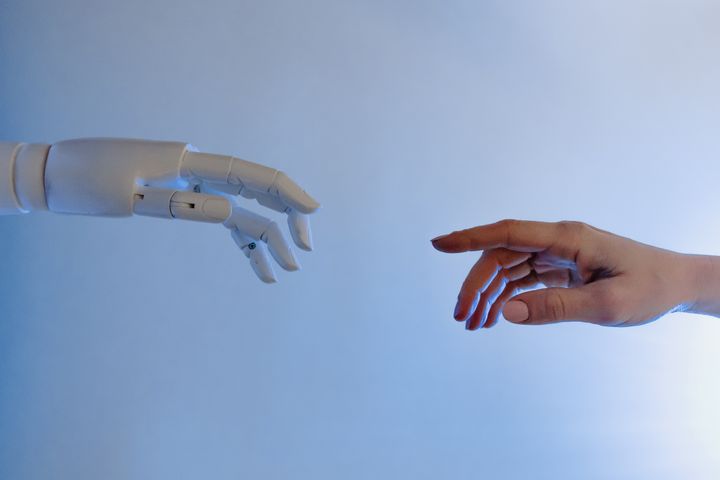
A quiet revolution happened this month — and it didn’t need a chatbot. Three developments across research, industry infrastructure, and high-profile consolidation are converging to prove that AI is finally learning to move.
Huawei/TU Darmstadt/ETH Zurich: Natural Language Now Controls Robots
A landmark paper in Nature Machine Intelligence demonstrated a breakthrough that researchers have chased for decades: robots that understand plain English commands without pre-programmed scripts. The joint Huawei/TU Darmstadt/ETH Zurich team showed how large language models can serve as the cognitive backbone for robotic control systems, interpreting intent and translating it into physical motion in real time.
The implications ripple across every sector imaginable — warehouse logistics, surgical assistance, disaster response. When “pick up the red box and place it by the door” becomes a valid programming instruction, the barrier to robotics deployment drops dramatically. Human-robot collaboration moves from scripted choreography to genuine teaming.
PAL Robotics: ROS 1 to ROS 2 Migration Complete
Europe’s leading open-source robotics platform reached a milestone this April. PAL Robotics successfully migrated its entire fleet — including the REEM-C and TIAGo lines — from ROS 1 to ROS 2, unlocking the faster real-time communication and enhanced security layers that the newer framework offers.
The shift matters because ROS 2’s deterministic timing and built-in Quality of Service settings are essential for production environments where milliseconds and message reliability aren’t optional. For developers and system integrators, the migration signals that the industry has crossed a threshold: the old standard is officially retired, and the ecosystem is ready to build at scale.
SpaceX and xAI: $1.25 Trillion Vertically Integrated AI Entity Formed
The biggest story in AI infrastructure this month wasn’t a research paper — it was a merger. SpaceX and xAI announced their consolidation into a single entity valued at $1.25 trillion, vertically integrating satellite communications, launch capacity, and AI model development under one roof.
The strategic logic is straightforward: compute infrastructure is now a strategic bottleneck, and owning your launch capacity means owning your compute refresh cycles. For the broader AI landscape, the merger signals that frontier AI development is becoming inseparable from physical infrastructure — data centers, satellite networks, and the machines that inhabit both Earth and orbit.
Key Takeaways
- Natural language control — LLM-driven robotics eliminates the need for bespoke code per task, collapsing deployment time from weeks to hours.
- ROS 2 is now production-grade — PAL’s migration proves the open-source framework is ready for real-world, mission-critical robotics at scale.
- Physical AI infrastructure — The SpaceX/xAI merger confirms that AI companies are buying the means of physical production, not just the software layer.
—
Published: April 17, 2026

Leave a Reply